The Art of Good Arguments
Learn to use them well.
Every time you raise your hand in class, defend an idea with a friend, or try to convince your parents to let you stay up later, you are making an argument.
Not the yelling kind. The thinking kind.
An argument is how you share what you believe and why you believe it. It is one of the most powerful skills a person can have. Great speakers, great leaders, and great problem-solvers all share one thing: they know how to make a point and make it well.
This book is your guide. You will learn the building blocks of every strong argument. You will discover ancient techniques that speakers have used for thousands of years. You will learn how to disagree without being disagreeable, how to spot persuasion in ads and speeches, and how to build your own compelling arguments from scratch.
Ready to build some bridges? Let's go.
"The art of persuasion is not about tricking people — it is about helping them see clearly."
"More Than Just Fighting"
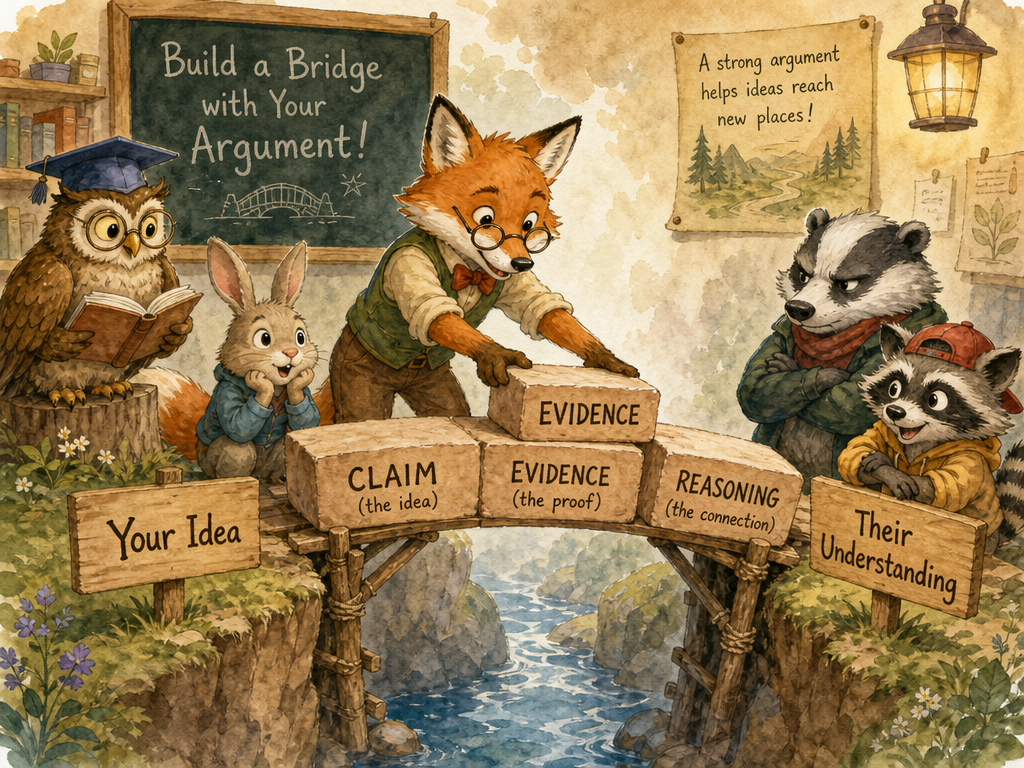
An argument is NOT a shouting match. In the world of thinking, an argument is a claim backed by evidence and connected by reasoning. That is it — three building blocks. Every strong argument you have ever heard, from a courtroom speech to a science presentation, is built from these three pieces.
Claim: What you believe. Evidence: The proof that supports it. Reasoning: The explanation of how the proof connects to your claim.
THE CLASS DEBATE
See the difference? The weak version is just a wish. The strong version gives your listener a reason to agree with you.
CONVINCING YOUR PARENTS
The strong version shows you have thought it through. Parents respond to evidence and planning, not just begging.
THE SCIENCE FAIR
The weak version is just a statement. The strong version shows the claim, then backs it up with data and an explanation.
Without all three pieces, your argument has holes. A claim without evidence is just an opinion. Evidence without reasoning is just a pile of facts. And reasoning without a claim has no destination. When you learn to combine all three, people listen.
Next time you want to make a point, ask yourself three questions: What do I believe? (That is your claim.) What proof do I have? (That is your evidence.) Why does that proof support my belief? (That is your reasoning.) If you can answer all three, you have an argument.
Pick one of these claims and build a full argument with evidence and reasoning:
Write down your claim, one piece of evidence, and the reasoning that connects them.
"Says Who?"
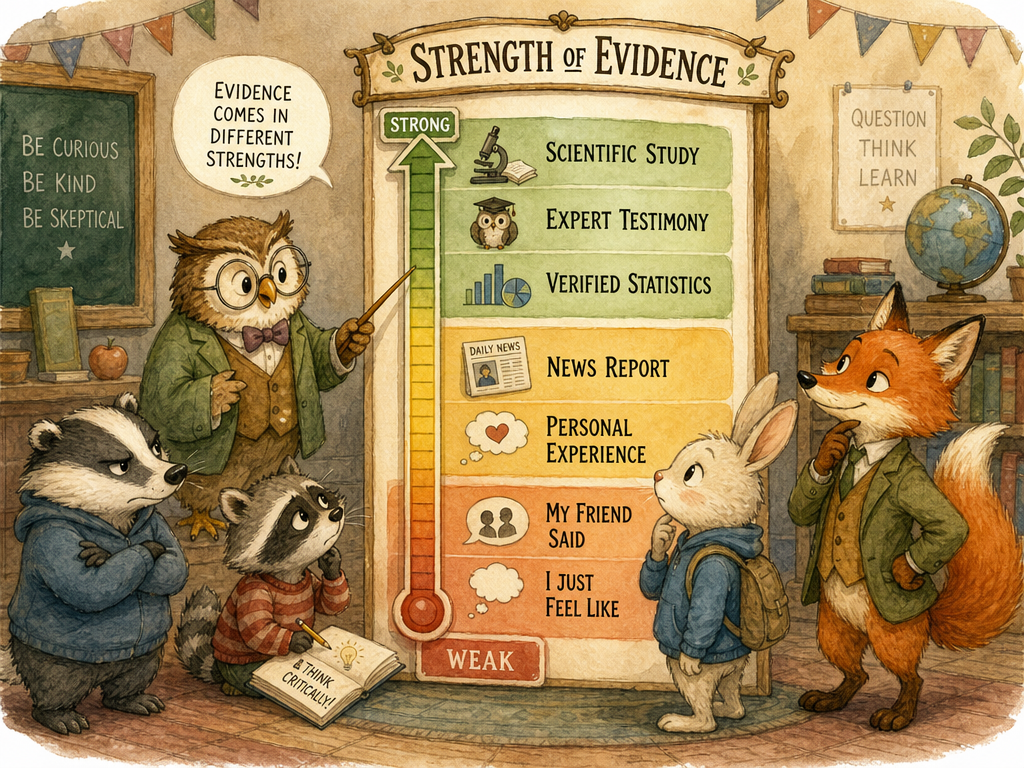
Not all evidence is created equal. "My friend said so" is evidence, but it is weak. "A study of 10,000 students found..." is much stronger. Learning to tell the difference between strong and weak evidence is a superpower. Facts beat opinions. Data beats anecdotes. Experts beat random people.
THE BOOK REPORT DEBATE
One friend's opinion is a single data point. Awards, translations, and thousands of ratings paint a much bigger picture.
THE STUDENT COUNCIL PROPOSAL
"Everyone hates it" is a feeling. A survey with numbers is something the principal can actually act on.
THE LATER BEDTIME REQUEST
Citing a medical authority and doing the math makes this almost impossible to argue against.
Weak evidence makes your argument wobbly, like a table with one leg. Strong evidence makes it solid. The person you are trying to convince will always ask (even silently), "Says who? How do you know?" If your answer is "I just feel like it," you have already lost.
Rank your evidence using this ladder, from weakest to strongest: Personal opinion (weakest) → Anecdote (one person's story) → Survey or poll → Expert testimony → Scientific study (strongest). Always try to climb as high as you can on the ladder.
You want to argue that your school should start 30 minutes later. Rank these pieces of evidence from weakest to strongest:
"Why Should I Listen to You?"
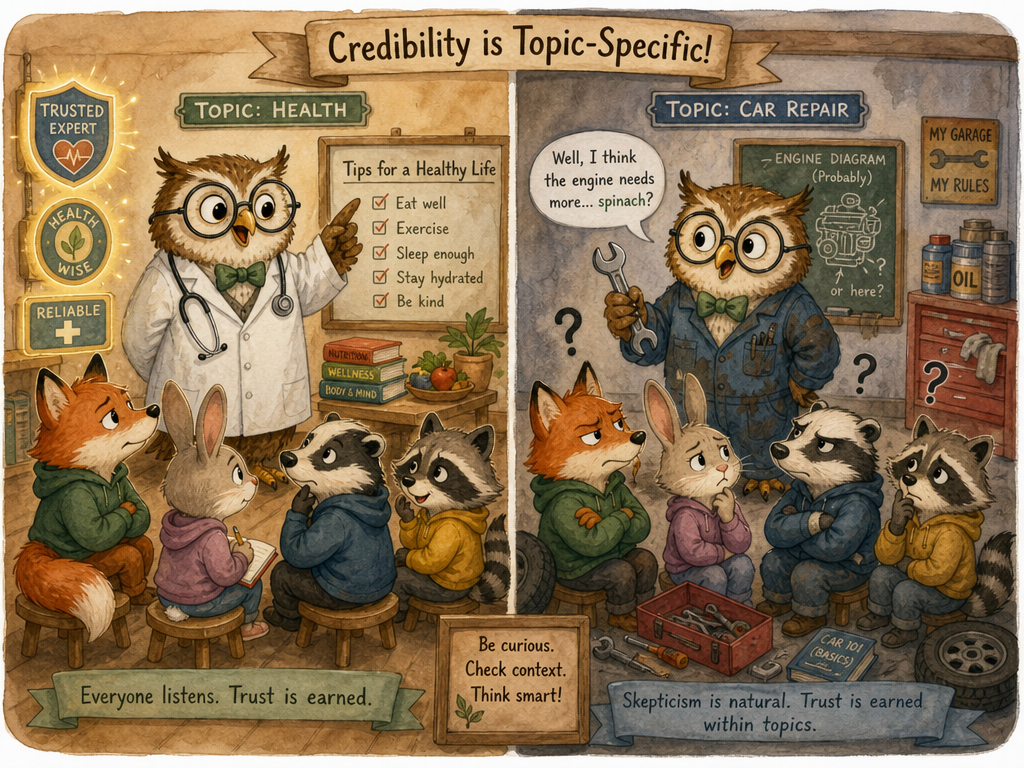
Ethos is a Greek word that means "character." It is the art of making people trust you so they will trust your argument. Think about it: you trust a doctor about health, a mechanic about cars, and a chef about cooking. Why? Because they have credibility — knowledge, experience, and a reputation for being honest. You can build ethos too.
THE CLASS PRESIDENT SPEECH
The second version builds trust by showing a track record. You are not just promising — you are proving.
THE GROUP PROJECT
Showing your knowledge makes people want to follow your lead. You are earning the right to be heard.
BEING HONEST BUILDS ETHOS
Admitting what you do NOT know actually makes people trust you more. It shows you are honest, not just telling them what they want to hear.
People do not just listen to arguments — they listen to people. If they trust you, your words carry weight. If they do not, even a perfect argument falls flat. Ethos is why a firefighter's warning about fire safety hits different than a random stranger's.
Build your ethos with these three moves: 1. Know your stuff — research before you speak. 2. Be honest — admit what you do not know. 3. Show your track record — remind people of times you followed through.
You want to convince your teacher to let the class have a movie day. Write an opening sentence that builds your ethos. Think: What have you done that makes you credible on this topic?
"Pulling Your Heartstrings"

Pathos means "feeling" in Greek. It is the art of using emotions — joy, sadness, hope, anger, empathy — to make your argument connect on a human level. Stories, vivid language, and personal connections make arguments come alive. But here is the catch: emotion without evidence is manipulation. Emotion WITH evidence is powerful.
THE ANIMAL SHELTER PRESENTATION
The story about Biscuit makes you FEEL something. Now you want to help. That is the power of pathos.
GOOD PATHOS VS. BAD PATHOS
Good pathos invites empathy and backs it up with a fact. Bad pathos uses guilt and exaggeration to force a reaction. One persuades. The other manipulates.
THE SCHOOL TRIP PITCH
This uses a shared happy memory and paints a vivid picture of the future. It makes people excited, not scared.
Humans are emotional creatures. Facts alone rarely change minds. But facts wrapped in a story that makes you feel something? That is how movements start. The key is using emotion to illuminate the truth, not to hide it.
Add pathos by: 1. Telling a specific story (not "kids are hungry" but "a boy named Marcus skips lunch three times a week"). 2. Using vivid language that paints a picture. 3. Connecting to shared experiences your audience already cares about. Always pair your emotion with real evidence.
Rewrite this boring argument using pathos (but keep it honest!):
Try telling a quick story or painting a picture that makes people care about this issue.
"Does It Actually Make Sense?"
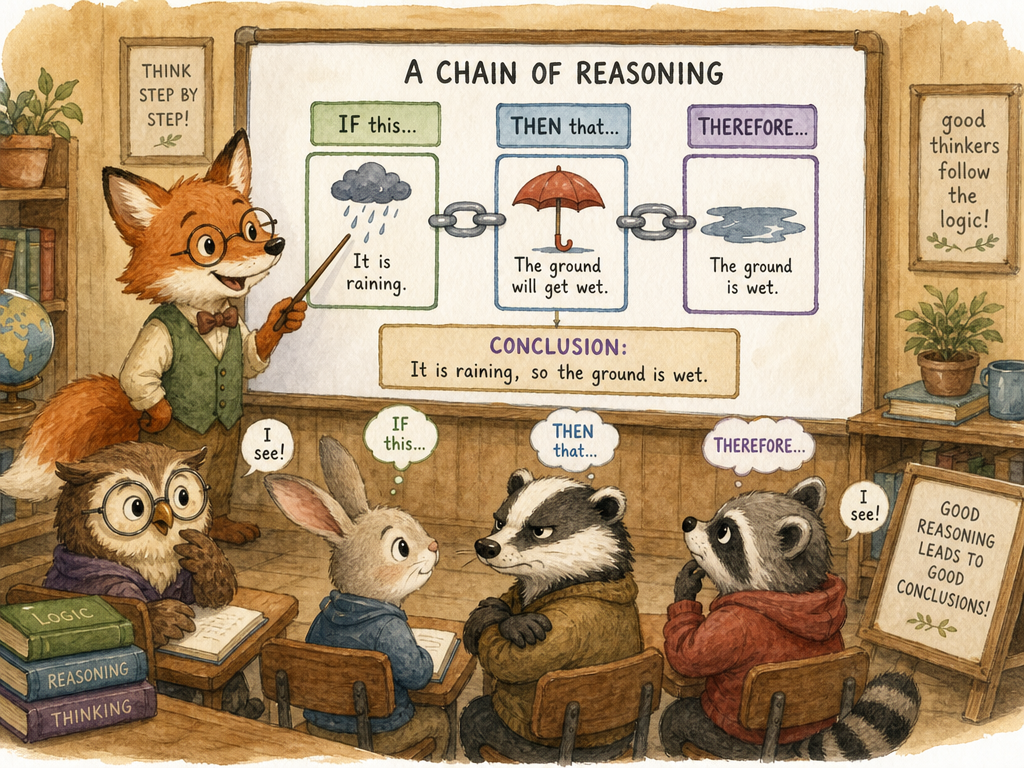
Logos means "reason" in Greek. It is the logical structure of your argument — the if-then chains, the cause-and-effect connections, the analogies that make your case airtight. If ethos makes people trust you and pathos makes people feel, logos makes people think, "Yeah, that actually makes sense."
IF-THEN REASONING
Each step logically leads to the next, like links in a chain. That is logos at work.
ANALOGY (COMPARING TWO THINGS)
This analogy connects something unfamiliar (sleep science) to something the audience already understands (athletes need fuel). It makes the logic click.
WEAK LOGOS VS. STRONG LOGOS
The strong version uses specific numbers and cause-and-effect reasoning. It shows the HOW and WHY, not just the WHAT.
Emotion gets people's attention, but logic keeps it. When your argument makes logical sense, it is very hard to disagree with. Logos is what separates a persuasive argument from a persuasive feeling. The best arguments have both.
Strengthen your logos with these tools: 1. If-then chains (If A, then B, then C). 2. Analogies (This is like...). 3. Numbers and data (specific beats vague). 4. Cause and effect (X leads to Y because...).
Build an if-then chain for this claim: "Students should be allowed to listen to music during independent work time."
"Once Upon a Point..."
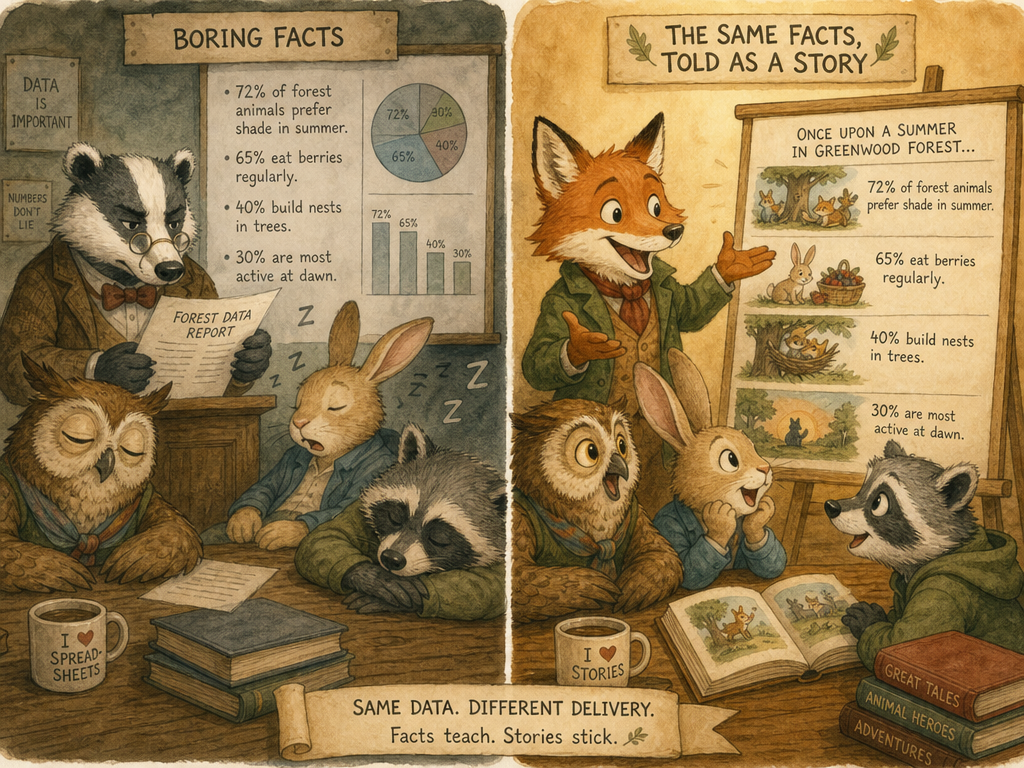
Stories are the oldest and most powerful persuasion tool humans have. Long before there were textbooks or statistics, people changed minds with stories. Why? Because our brains are wired for narrative. A list of facts is forgettable. A story that illustrates those facts? Unforgettable. When you wrap your argument in a story, people do not just understand your point — they experience it.
THE RECYCLING CAMPAIGN
The statistic is interesting. The story about Mr. Ruiz and the nine bags is something you will remember next time you are about to throw away a bottle.
THE SPORTS TEAM ARGUMENT
This story takes the abstract idea of "extra practice is good" and makes it concrete, emotional, and memorable.
THE STORY STRUCTURE
Setup → Conflict → Connection. Memorize this structure and you can turn any argument into a story.
Research shows people are 22 times more likely to remember a fact when it is embedded in a story. Stories bypass our defenses. When someone gives you a statistic, your brain evaluates it. When someone tells you a story, your brain lives it. That is why every great speech, every great leader, and every great teacher uses stories.
Before your next presentation, find ONE real story that illustrates your main point. Use the Setup → Conflict → Connection structure. Keep it short (30 seconds to 1 minute). Make it specific — names, places, and details make stories real.
Turn this dry argument into a story using Setup → Conflict → Connection:
Who could be your main character? What happened to them? How does it connect to your point?
"Yeah, But..."
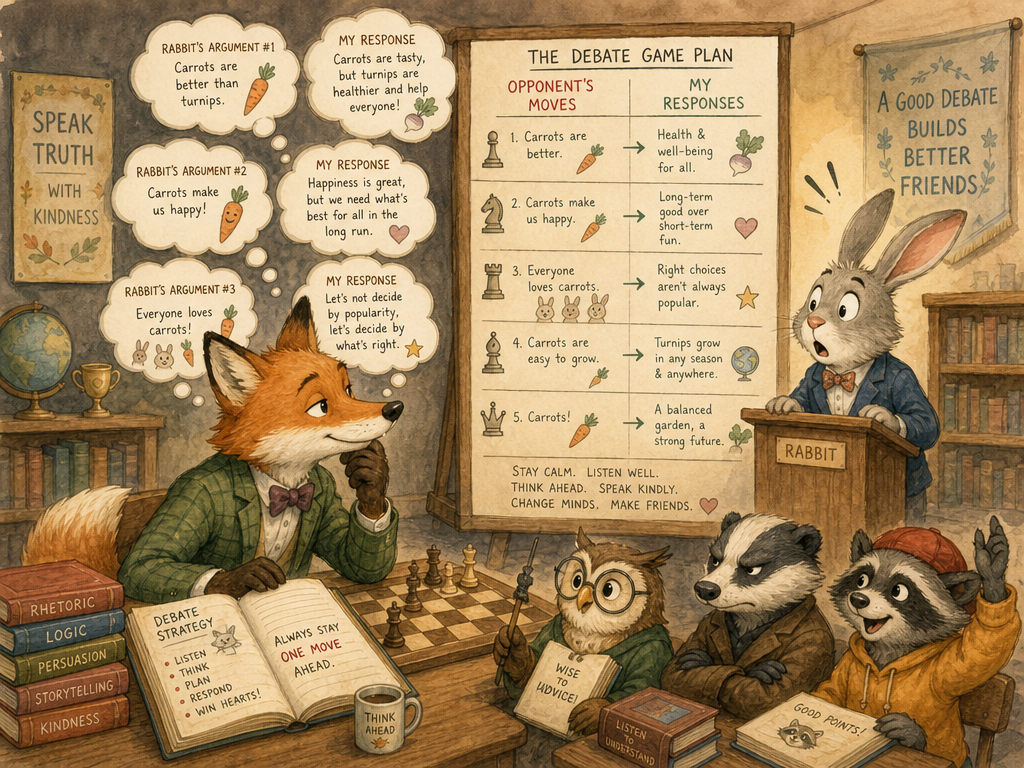
A counterargument is the other side's best point. And here is the secret weapon most people miss: bringing up the other side's best point before they do makes YOUR argument stronger, not weaker. It shows you have thought about the issue from all sides. It is the difference between a good debater and a great one.
There are two ways to handle the other side: Steel-manning (presenting their best argument fairly) vs. Straw-manning (distorting their argument to make it easy to knock down). Great arguers always steel-man.
THE PET REQUEST (STEEL-MAN VERSION)
By admitting the concern is fair and addressing it head-on with a plan, you disarm the counterargument before it even gets raised.
STRAW-MAN VS. STEEL-MAN
The straw-man distorts. The steel-man respects, then responds. Which one would YOU find more convincing?
THE DEBATE TOURNAMENT
By naming the objection first, you control the narrative. The audience thinks, "Wow, they already thought about that."
Ignoring counterarguments is like leaving a hole in your armor. Someone WILL find it. But addressing counterarguments yourself shows confidence, honesty, and thorough thinking. Judges in debate, teachers grading essays, and parents hearing requests all value this. It is the hallmark of a mature thinker.
Before presenting any argument, ask yourself: "What is the BEST reason someone might disagree with me?" Then address it directly using this formula: "Some might say ___. That is a fair point. However, ___." This three-part move (acknowledge, validate, respond) is incredibly powerful.
You are arguing: "Students should be allowed to use phones during lunch." What is the strongest counterargument? Write it out, then respond to it fairly.
"Attack the Idea, Not the Person"
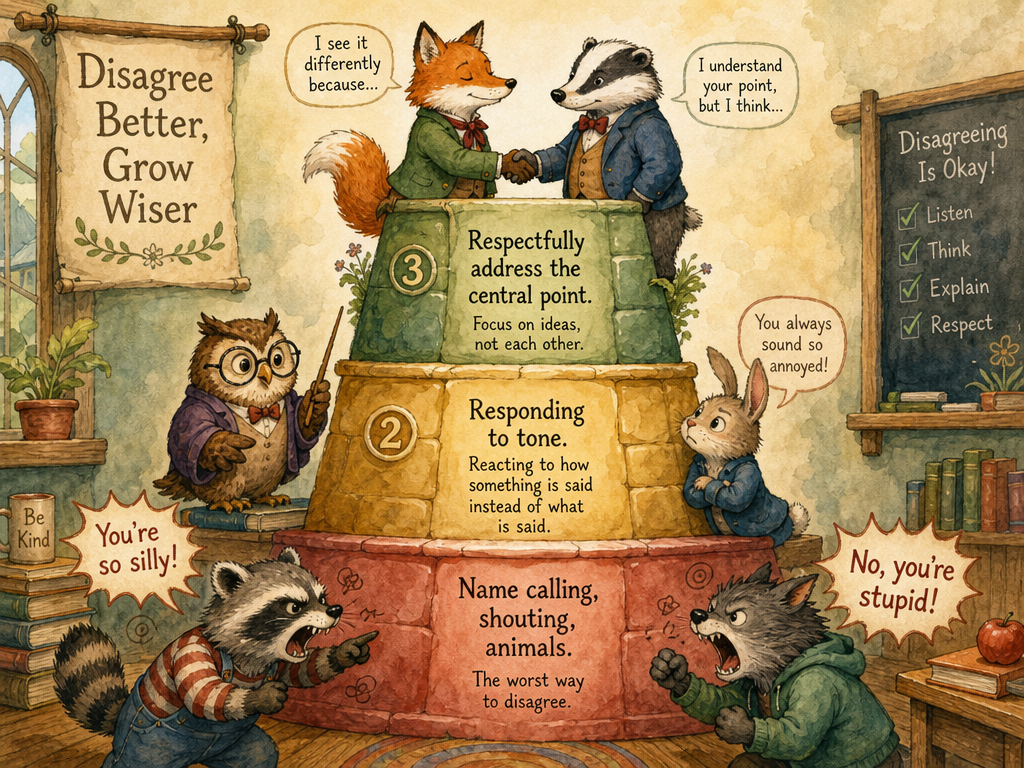
Disagreement is not bad. In fact, it is essential. Without disagreement, we would never improve ideas, fix mistakes, or discover better solutions. But there is a HUGE difference between disagreeing well and disagreeing badly. The disagreement hierarchy ranks responses from worst to best:
Worst: Name-calling → Personal attacks → Tone criticism → Contradiction → Counterargument → Refutation → Best: Refuting the central point
THE DISAGREEMENT LADDER
See how the quality goes up at each level? The best disagreement tackles the strongest part of the other person's argument — and offers an alternative.
THE FRIEND DISAGREEMENT
The good version disagrees with the IDEA without insulting the PERSON. You can be firm and still be kind.
THE MAGIC PHRASES
These phrases show respect while still allowing you to disagree firmly. They keep the conversation going instead of shutting it down.
People who can disagree well are the ones who actually change minds. If you attack the person, they get defensive and stop listening. If you attack the idea respectfully, they are more likely to reconsider. Being firm AND respectful is a rare and valuable combination.
Three rules for disagreeing like a pro: 1. Start with what you agree on — find common ground first. 2. Target the idea, not the person — say "that argument" not "you." 3. Offer an alternative — do not just tear down, build up.
Your friend says: "Homework is pointless and should be completely eliminated." You disagree. Write a response that climbs to at least Level 5 on the disagreement hierarchy:
"Ads, Influencers, and Speeches"
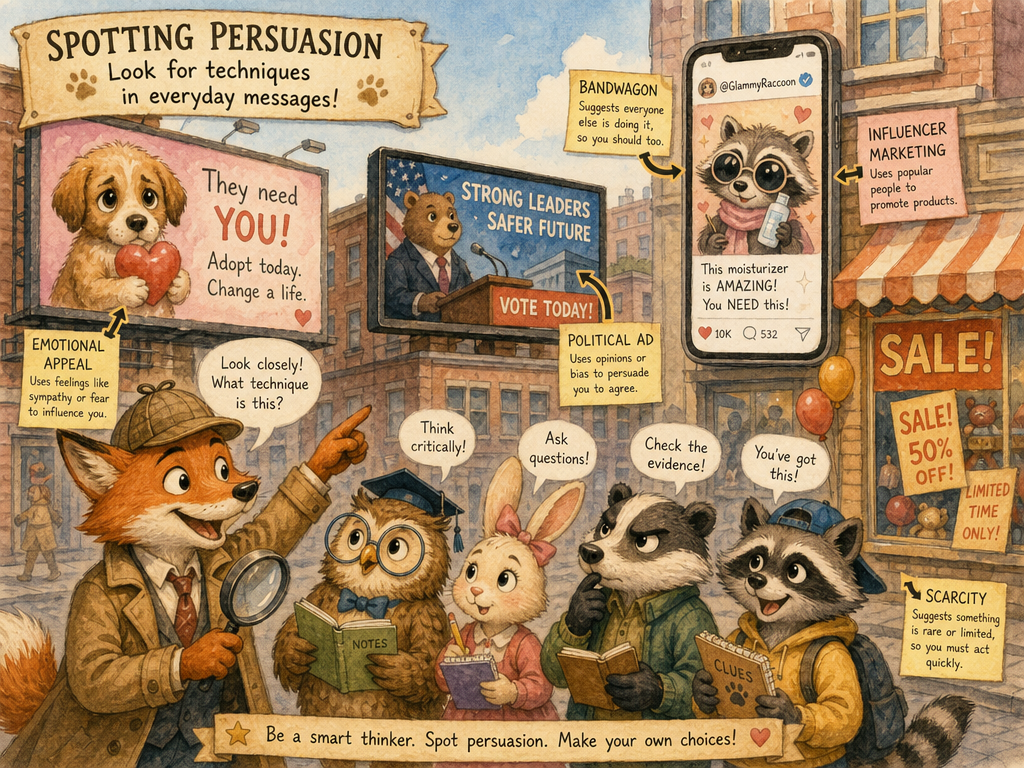
Now that you know the tools of persuasion, you will start seeing them everywhere. Ads, political speeches, influencer posts, movie trailers, product reviews — they all use ethos, pathos, logos, and stories to change your mind. This is not necessarily bad! But being aware of how you are being persuaded makes you a smarter consumer, voter, and thinker.
THE INFLUENCER POST
Ethos: They are using their popularity as credibility (but are they a nutritionist?). Pathos: "Changed my life" is emotional, not factual. Missing logos: No data, no comparison, no evidence. Plus, they are getting PAID to say this. Always ask: is this a genuine recommendation or a paid ad?
THE MOVIE TRAILER
Ethos: "#1 movie" builds credibility. Pathos: Epic music, dramatic shots. Trick: "Critics call it breathtaking" — which critics? One out of fifty? Trailers use the best 2 minutes of a 2-hour movie.
THE PRODUCT REVIEW
Specific, balanced reviews use logos. Vague, all-positive reviews might be paid or fake. Look for reviewers who mention pros AND cons.
THE POLITICAL SPEECH
Good speeches combine ALL the tools. Now that you know what to listen for, you can evaluate whether the speaker is persuading fairly or manipulating.
You are exposed to thousands of persuasion attempts every day — from cereal boxes to social media algorithms. Being aware does not make you cynical. It makes you free. You get to choose what to believe based on evidence and logic, not because someone with a big following told you to.
Next time you see an ad or hear a pitch, play "Spot the Technique": 1. Is this using ethos, pathos, or logos? 2. Is there actual evidence, or just emotion? 3. Is the person being paid to say this? 4. What is the counterargument they are NOT mentioning?
Find a real ad (on a website, a magazine, or TV) and break it down:
"Your Turn!"
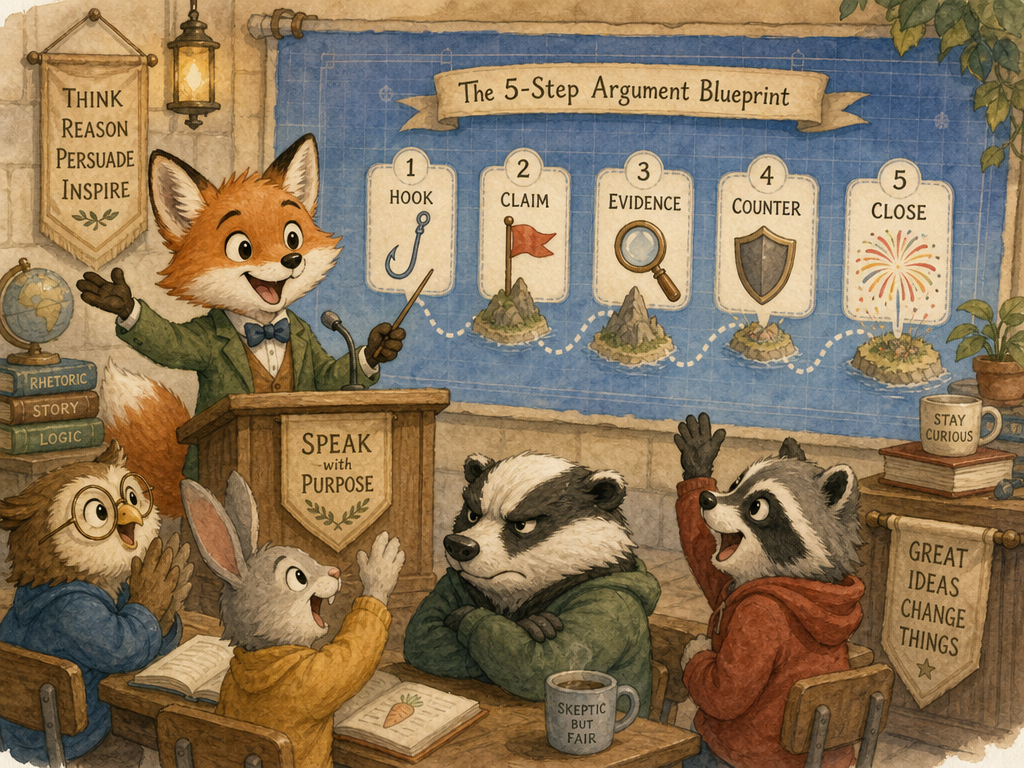
You have learned the tools. Now it is time to use them. This chapter gives you a step-by-step template for building any persuasive argument or speech, from a two-minute class presentation to a full debate. Think of it as your argument blueprint. Every great building starts with a blueprint, and every great argument does too.
THE 5-STEP BLUEPRINT
Hook → Claim → Evidence → Counter → Close. Five steps. That is the whole framework. Every great speech follows this pattern in some form.
A COMPLETE EXAMPLE: THE NEW PET SPEECH
Notice how this uses ALL the tools: ethos (research, savings, a plan), pathos (the shelter dog waiting), logos (costs, schedule, data), story (the shelter visit), and a counterargument. That is a complete argument.
PRO TIPS
Delivery matters as much as content. A great argument mumbled into your shoes loses its power.
The ability to stand up, organize your thoughts, and make a compelling case is one of the most valuable skills you will ever develop. It works in school presentations, job interviews, college essays, and everyday conversations. The people who change the world are the ones who learn to make their point.
Use this template for ANY argument: 1. Hook (grab attention) → 2. Claim (state your point) → 3. Evidence (prove it) → 4. Counter (address the other side) → 5. Close (end strong). Write it out, practice it, deliver it.
Pick a topic you care about and fill in the template:
Then read it out loud. Congratulations — you just built a real argument!
The 5-step speech template you can use for anything
You now have tools that most adults never learned. You know how to build a claim, back it up with evidence, make people feel your argument, and address the other side fairly.
The world has too many people who argue by shouting, name-calling, and ignoring evidence. It does not need more of that. It needs people like you — people who can disagree respectfully, persuade honestly, and change minds with reason instead of volume.
Your words have power. Now go use them well.