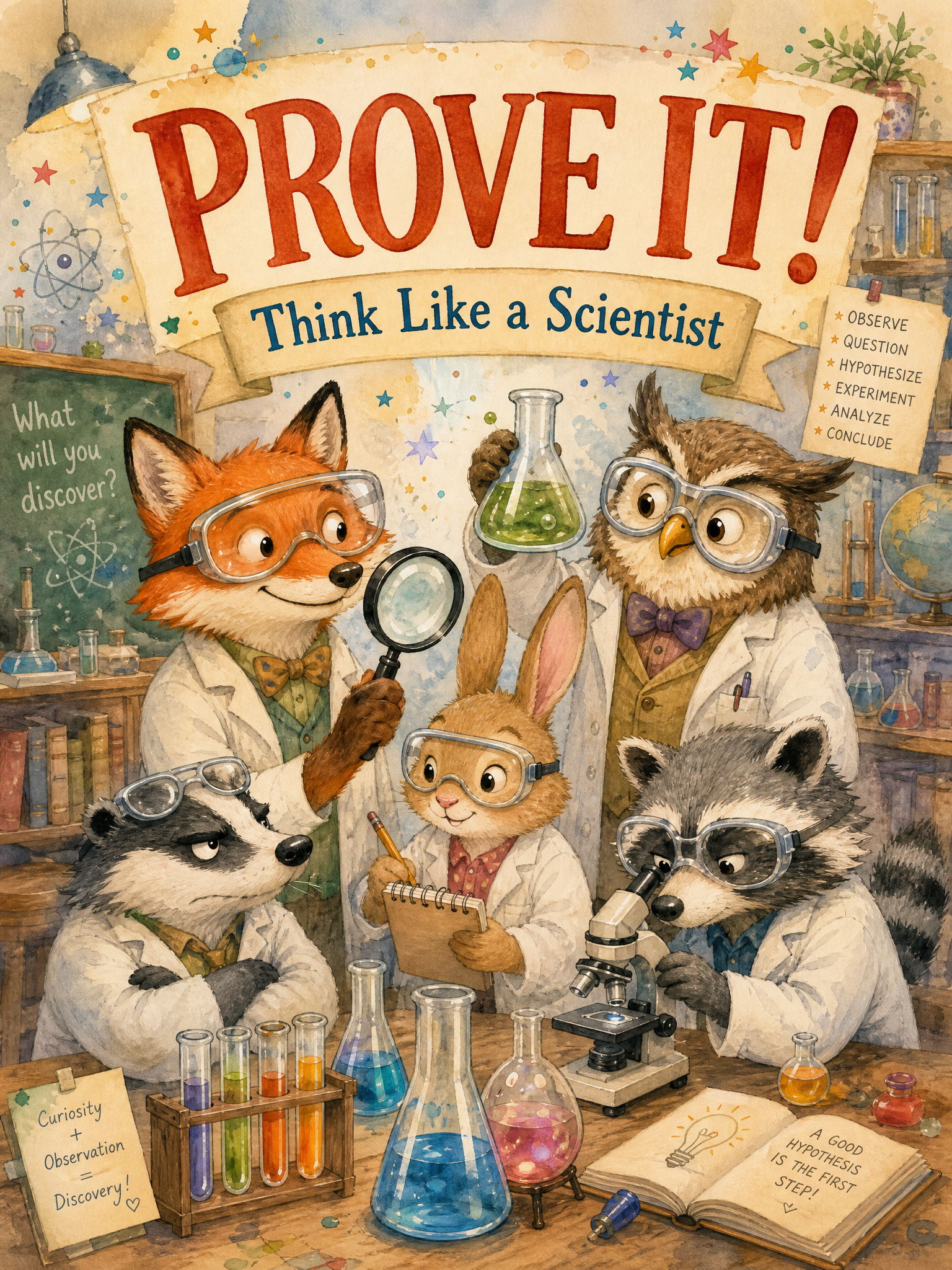
Think Like a Scientist
You don't need a lab coat. You need a toolkit.
When you hear the word "scientist," you probably picture someone in a white coat, holding a bubbling beaker. But here's the secret: scientific thinking has nothing to do with lab coats.
Scientists are just people who got really, really good at figuring out what's actually true — and what only seems true. They built a toolkit for testing ideas, and that toolkit works everywhere: in science class, on the basketball court, during arguments with your friends, and when you're deciding what to believe online.
This book will teach you 10 tools that scientists use every day. You don't need to memorize formulas or know the periodic table. You just need to be curious — and willing to ask, "But how do we actually know that?"
Ready to upgrade your brain? Let's go.
"Somewhere, something incredible is waiting to be known." — Carl Sagan
"What did you actually see?"
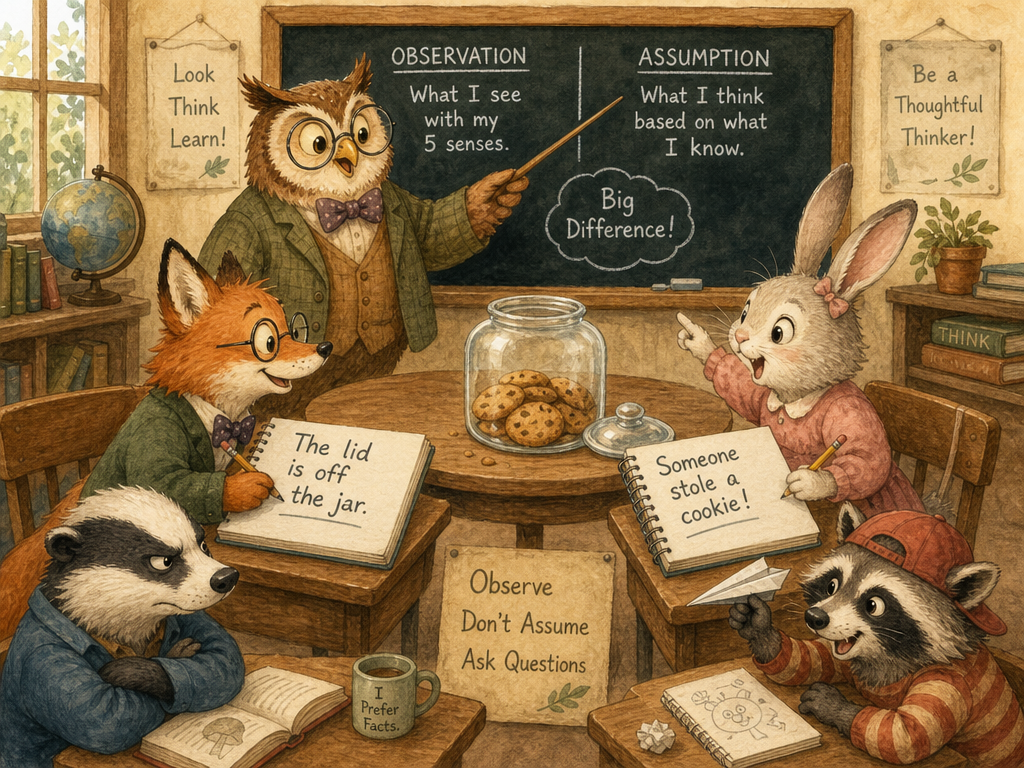
An observation is something you directly see, hear, measure, or record. An assumption is a story your brain makes up to fill in the gaps. Your brain does this constantly — and it's often wrong. Scientists train themselves to separate what they actually noticed from what they think happened.
AT LUNCH
Observation: Marcus sat alone. Assumption: He's sad. You saw the first one. You invented the second.
THE MISSING COOKIES
Our brains love to connect dots — even when the dots don't actually connect.
THE SCIENCE FAIR
Good observation. But the conclusion skipped over other possible explanations.
When you mix up observations and assumptions, you end up believing things that aren't true. You accuse people unfairly, jump to wrong conclusions, and miss the real explanation. Detectives who do this arrest the wrong person. Scientists who do this publish wrong results.
Before you draw a conclusion, ask: "What did I actually see or measure? And what am I just guessing?" Write down only what you directly observed. Everything else is a hypothesis that needs testing.
Look out your window for 60 seconds. Write down ONLY observations (things you can see, hear, or count). Then write your assumptions separately. Example: "I see a wet sidewalk" is an observation. "It rained" is an assumption — someone might have been washing their car!
"My best guess (that I can test)"
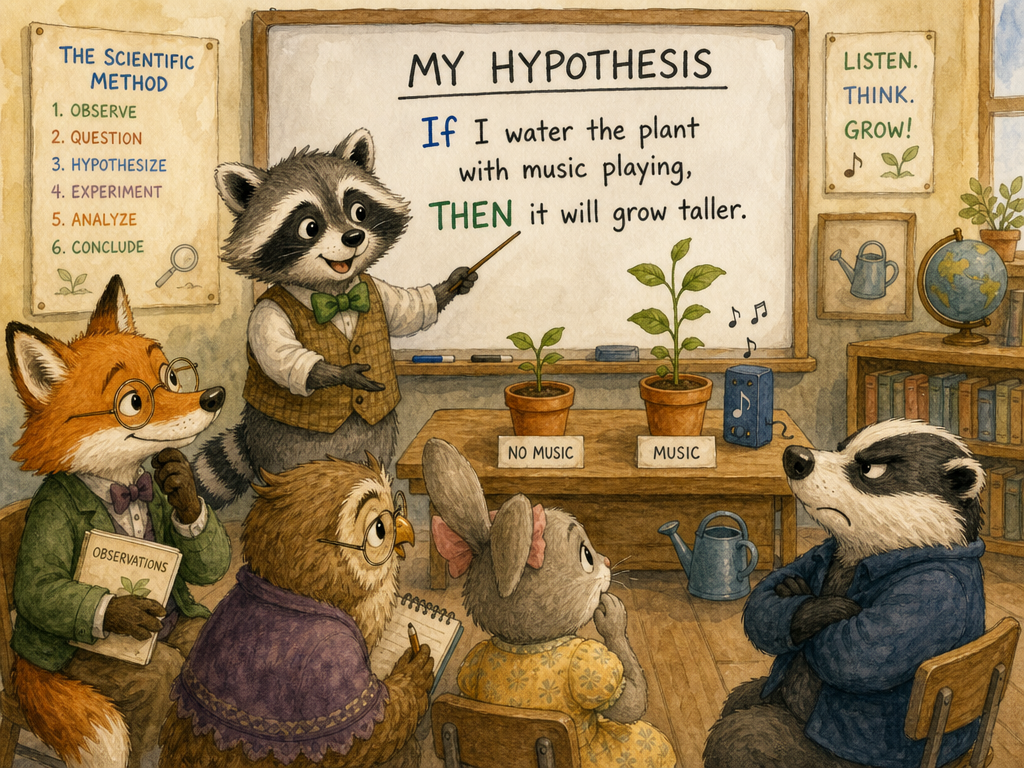
A hypothesis isn't just any guess — it's a specific prediction you can actually check. "I think dogs are cool" is an opinion. "I think dogs will choose a meat treat over a veggie treat 8 out of 10 times" is a hypothesis. The difference? You can run an experiment to see if the second one is true.
THE BASKETBALL COURT
The second one is specific, measurable, and you'll know by Friday if it's right or wrong.
THE SCIENCE FAIR
The strong version tells you exactly what to measure, how long to wait, and what result would prove it right or wrong.
AT HOME
Now you have something you can actually measure and settle once and for all!
Without a clear hypothesis, you're just wandering. You don't know what you're looking for, what counts as success, or when you're done. It's like going on a road trip without a destination — you'll drive around forever and never arrive anywhere.
Use the "If... then..." format: "If I do [this specific thing], then [this measurable result] will happen." If you can't fill in both blanks with something you can test, it's not a hypothesis yet — keep refining.
Turn these opinions into testable hypotheses: (1) "Warm water dissolves sugar faster." (2) "People are nicer in the morning." (3) "Red cars get more speeding tickets." For each one, write an "If... then..." statement with specific, measurable details.
"What changed? What stayed the same?"
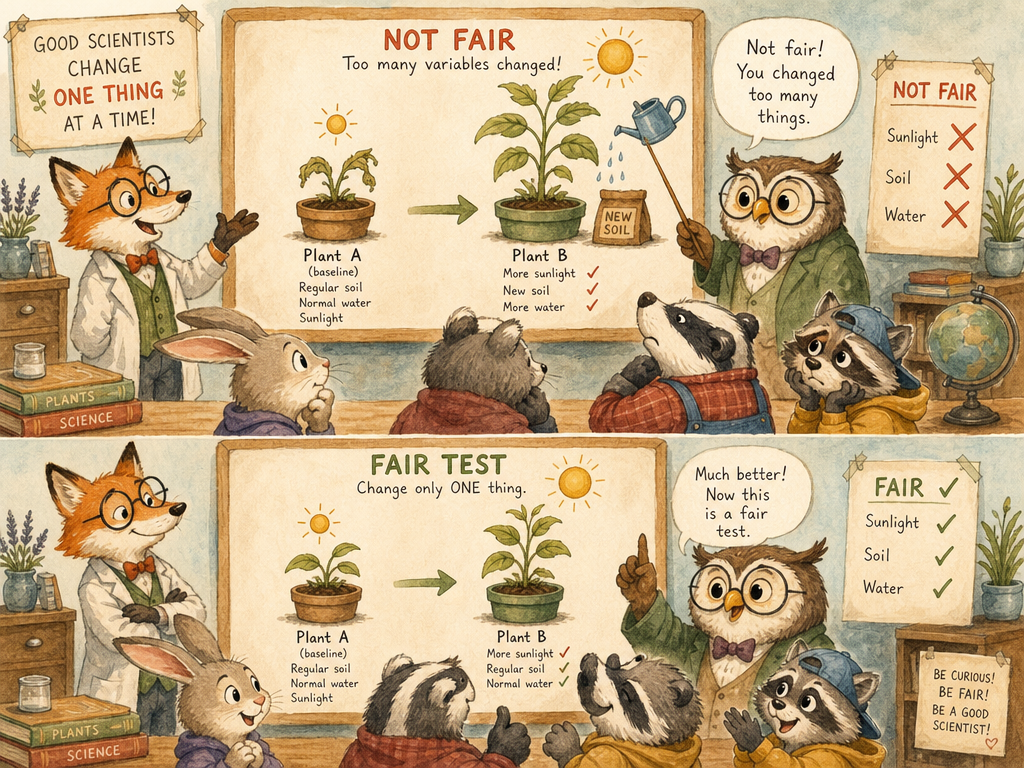
A variable is anything that can change in an experiment. The independent variable is the one thing YOU change on purpose. The dependent variable is what you measure to see if anything happened. Everything else? Those should stay the same — those are your controlled variables. Think of it like a cooking recipe: if you change the oven temperature AND the baking time AND the ingredients, you'll never know which change made the cookies taste different.
THE PAPER AIRPLANE CONTEST
If you changed the thrower AND the design, you wouldn't know which one made the difference.
STUDYING FOR A TEST
Too many variables changed at once. You can't tell which one made the difference.
THE COOKIE EXPERIMENT
One change at a time. That's how you find the real answer.
If you change multiple things at once, your results are meaningless. You might think the new fertilizer helped your garden, when really it was the extra rain last week. Keeping variables straight is how you avoid fooling yourself.
Before any experiment, make three lists: (1) What am I changing? (just ONE thing), (2) What am I measuring?, (3) What am I keeping the same? If your first list has more than one item, simplify.
Design a test: "Does the color of a cup affect how hot the drink stays?" Identify your independent variable (cup color), dependent variable (temperature over time), and at least 3 things you'd keep the same. Could you run this at home?
"The fair test"
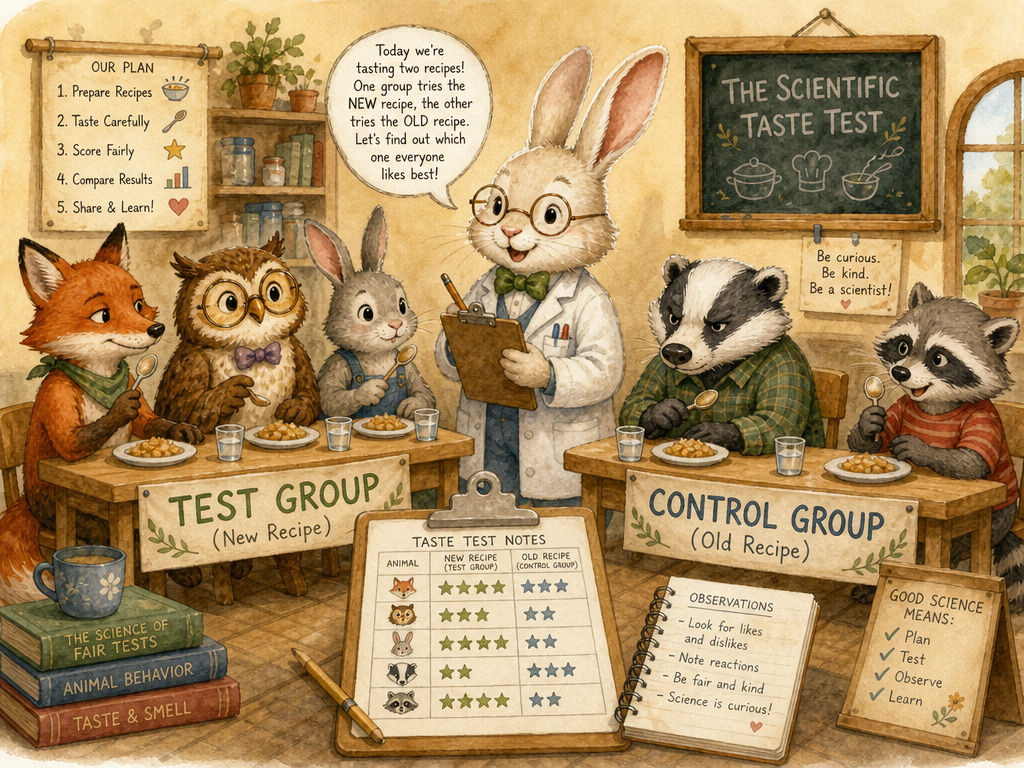
A control group is the "do nothing different" group in an experiment. It shows you what happens without your change so you can compare. Without a control, you're looking at a result and saying, "That's great!" — but great compared to what? A control is your baseline, your "normal," your before-picture.
THE SCIENCE FAIR
Without a control plant, "12 inches" might just be normal growth. You need a comparison!
THE NEW STUDY APP
A result means nothing without knowing what would have happened otherwise.
SPORTS TRAINING
Without a control group doing the old routine, you can't prove the new one is better.
Without controls, you give credit to things that didn't actually work. Companies sell useless products this way: "After using our cream, 90% of people felt better!" — but maybe 90% of people feel better doing nothing. That's why doctors use placebos — they're the ultimate control.
Whenever you test something, always ask: "What would have happened if I changed nothing?" Set up a group, a plant, a batch, or a trial where everything stays the same. That's your control. Compare your results to it.
Your friend says: "I ate a banana before my game and played amazing!" Design an experiment to test if bananas actually help. What's the control? (Hint: what would your friend eat — or not eat — on the control day?)
"Together doesn't mean because of"
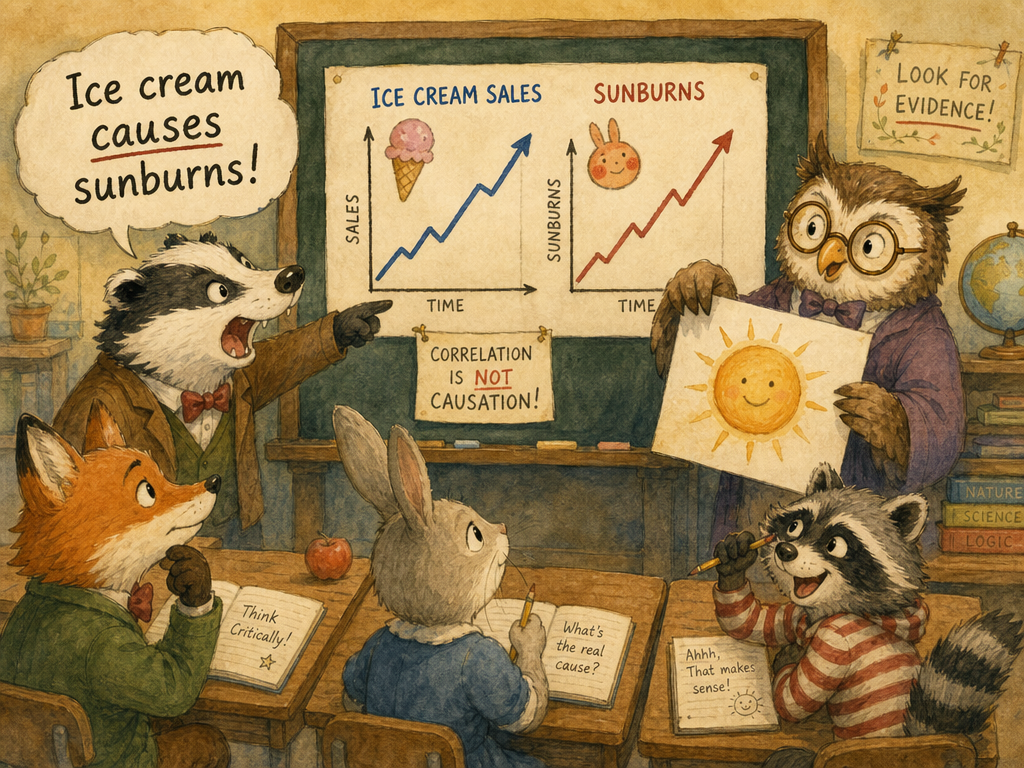
Correlation means two things happen together or follow a pattern. Causation means one thing actually makes the other happen. Just because two things show up at the same time doesn't mean one caused the other. Sometimes a hidden third thing is causing both!
THE CLASSIC EXAMPLE
Of course not! Hot weather is the hidden third factor. It causes BOTH more ice cream eating and more swimming (which leads to more drownings).
AT SCHOOL
The correlation is real, but the cause might be something deeper.
VIDEO GAMES
Headlines love to imply causation. Scientists demand proof of it.
A SILLY ONE
No! Bigger fires attract more firefighters AND cause more damage. The fire size is the hidden variable.
Mixing up correlation and causation leads to terrible decisions. You might ban something harmless or promote something useless. Companies exploit this all the time: "People who buy our product are happier!" — maybe happier people just buy more stuff.
When someone says "A causes B," ask three questions: (1) Could B actually cause A? (2) Could a hidden third thing cause both? (3) Is this just a coincidence?
What's the hidden third variable? (Hint: think about what both churches and crime have in common.)
"One time doesn't count"
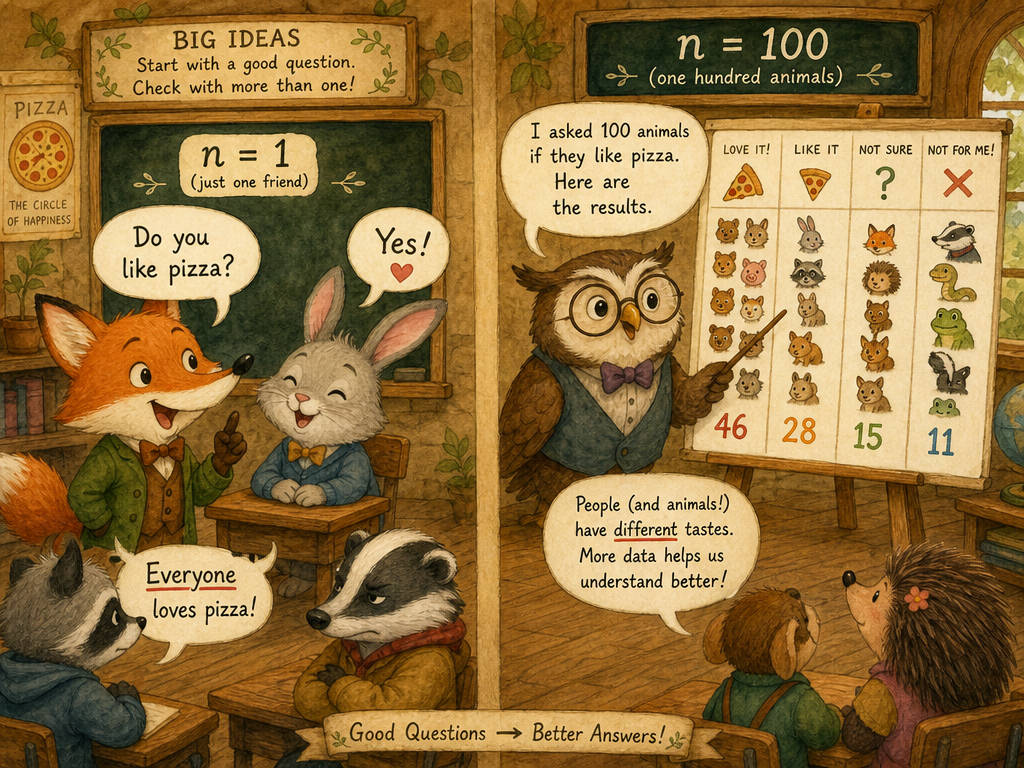
Sample size is how many times you test something or how many people you ask. Flipping a coin once and getting heads doesn't prove the coin is rigged. You need to flip it many times before you see the pattern. The bigger your sample, the more you can trust your results. One example proves almost nothing.
THE RESTAURANT REVIEW
One bad experience is an anecdote, not evidence.
THE CLASS SURVEY
A tiny sample can easily be unrepresentative. Those 3 might all be pizza lovers.
THE FREE-THROW TEST
Small sample sizes create illusions. You need enough data to see the real pattern.
Tiny samples lead to wild conclusions. A medicine that "worked" on 3 people might fail on 3,000. One good game doesn't make an MVP. Advertisers love tiny samples: "4 out of 5 dentists recommend it!" — they asked 5 dentists?
Always ask: "How many times was this tested? How many people were asked?" The smaller the number, the less you should trust the conclusion. And make sure the sample is representative — asking only your friends doesn't represent the whole school.
Flip a coin 10 times and record the results. Did you get exactly 5 heads and 5 tails? Probably not! Now imagine flipping 1,000 times — you'd get much closer to 50/50. That's why sample size matters.
"Do it again!"
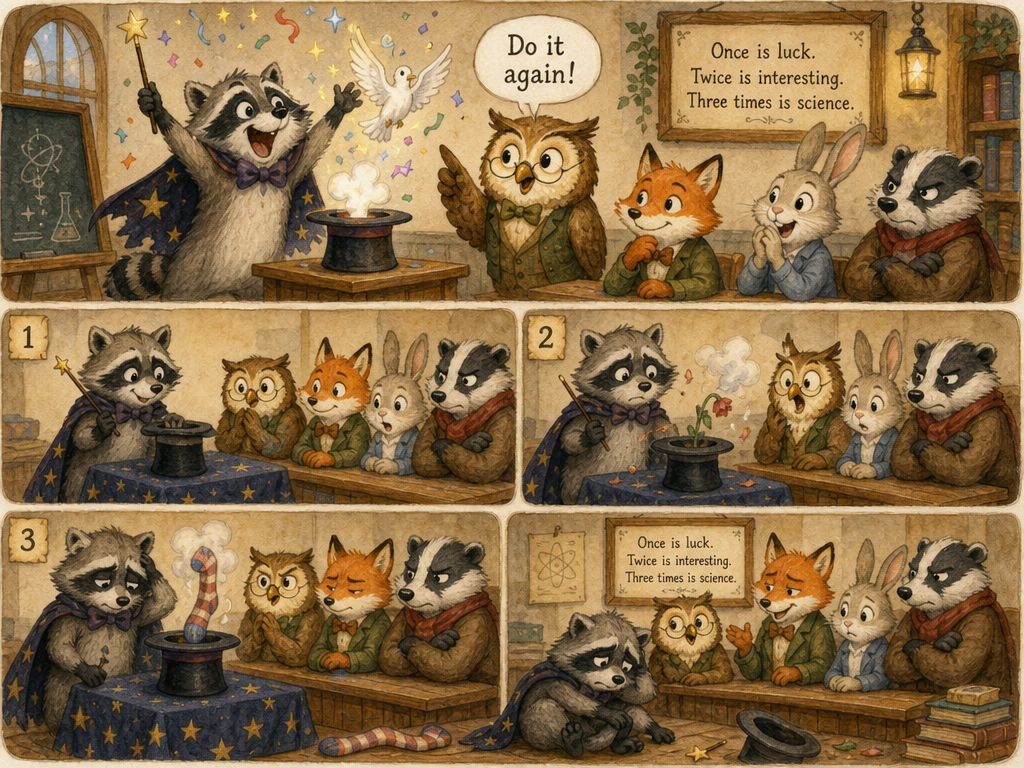
Replication means getting the same result when you (or someone else) repeats the experiment. A result that only happens once could be a fluke, a mistake, or just luck. But if you get the same answer over and over, and OTHER people get it too? Now you're onto something real.
THE MAGIC TRICK
If it works every time, it's real science. If it only worked once, something else might have happened.
THE "CURE"
A single success story isn't proof. You need it to work consistently, for many people.
THE VIDEO GAME STRATEGY
One win could be luck. Ten wins in a row? That's a real strategy.
Without replication, you believe in flukes. History is full of "breakthroughs" that no one could ever repeat. In 1989, scientists claimed they achieved cold fusion — unlimited energy! When others tried the same experiment, it didn't work. Not replicated? Not real.
After any experiment or test, ask two questions: (1) "Can I get this same result again?" and (2) "Can someone ELSE get this result?" If the answer to both is yes, your finding is solid.
Build a paper airplane and throw it 10 times, measuring the distance each time. Do you get the same distance every time, or does it vary? Now have a friend throw the same plane. Do they get similar results? That's replication in action!
"Check my work"
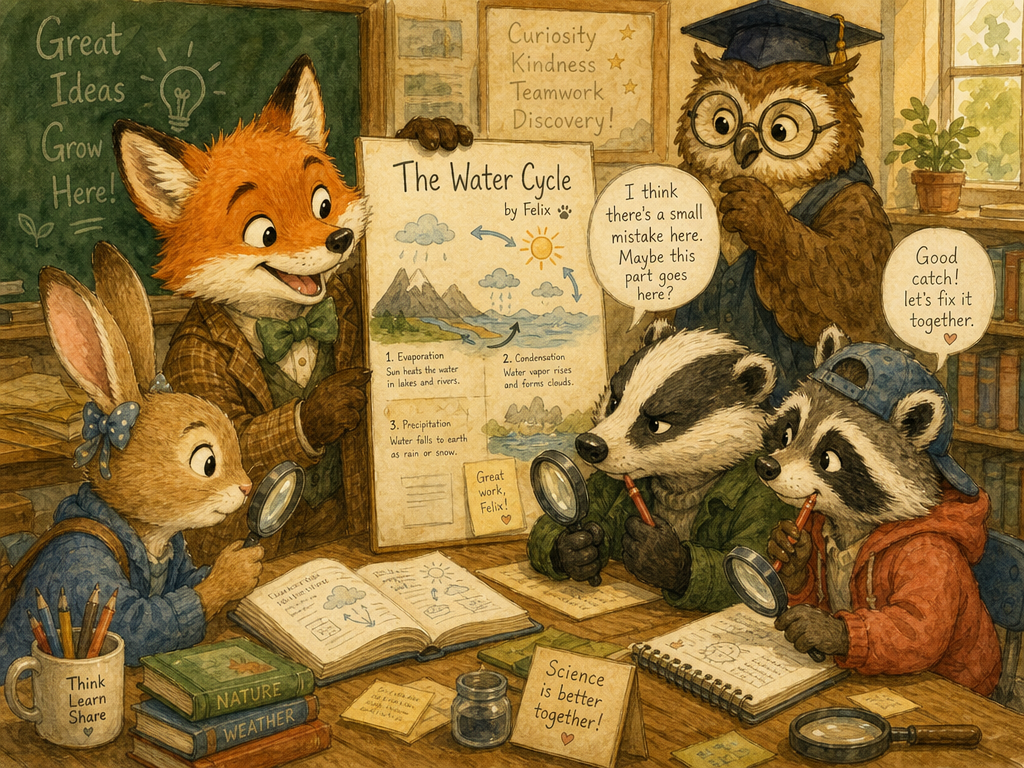
Peer review means having other knowledgeable people examine your work to find mistakes, gaps, or things you missed. Nobody is too smart to be wrong. Even the world's best scientists submit their work for others to critique before it's published. Fresh eyes catch what tired eyes miss.
THE ESSAY
You're too close to your own work to see its flaws. That's why peer review exists.
THE SCIENCE PROJECT
Your classmate spotted a flaw you missed. That's peer review saving you from a wrong conclusion.
THE GROUP PROJECT
Good teams welcome challenges. A plan that survives criticism is stronger than one that was never questioned.
Without peer review, mistakes go unnoticed. People publish wrong information, build on flawed results, and make bad decisions. Some of the biggest scientific scandals happened because someone faked data and nobody checked until years later.
Before you finalize anything important, ask someone to review it. Tell them: "Try to find problems. I want to make this better, not hear that it's perfect." And when someone reviews YOUR work, don't get defensive — get grateful.
Write a short argument for something you believe (e.g., "Summer is the best season"). Then trade with a friend and try to find 3 weaknesses in each other's argument. Did your friend find something you missed?
"The simplest explanation usually wins"
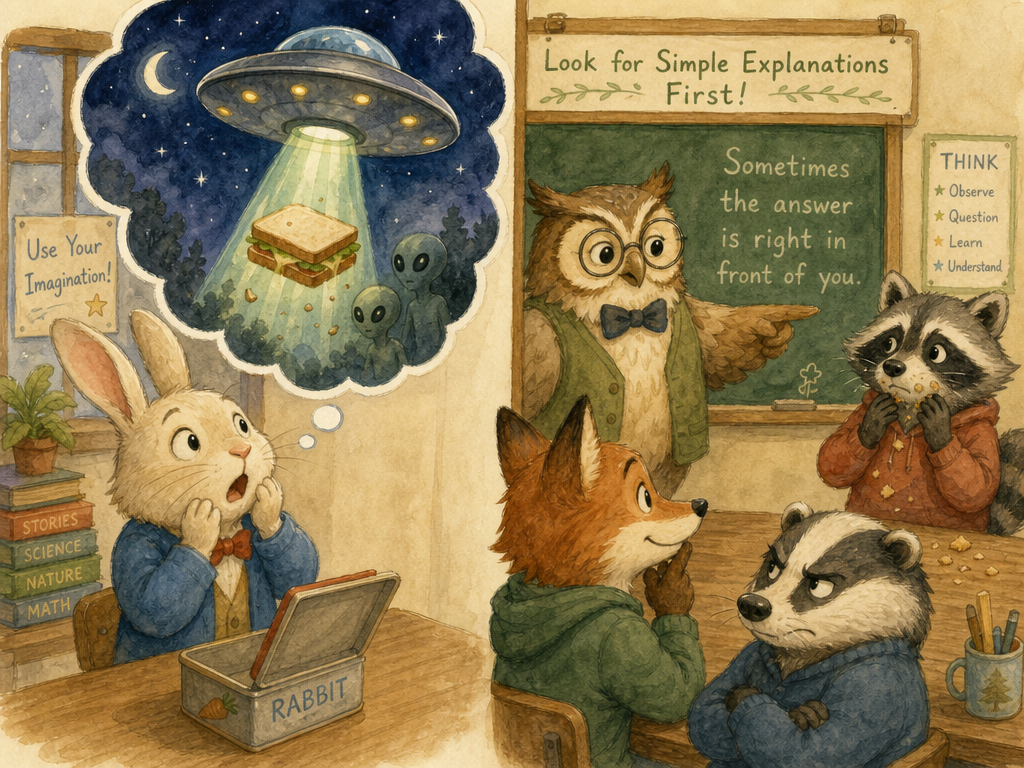
Occam's Razor says: when you have multiple explanations that all fit the facts, start with the simplest one. Don't assume aliens when "the wind knocked it over" works perfectly fine. The explanation that requires the fewest assumptions is usually the right one. (Named after William of Ockham, a thinker from the 1300s.)
THE MISSING HOMEWORK
Which explanation requires fewer assumptions? Nobody needed to break in. You probably just forgot.
THE STRANGE NOISE
You don't need a supernatural explanation when ordinary ones work perfectly.
THE CROP CIRCLES
Human pranksters with simple tools vs. interstellar travelers? Occam's Razor says start with the simple answer.
Without Occam's Razor, every mystery becomes a conspiracy. Every coincidence becomes proof of something huge. You end up believing in complicated, unlikely explanations when a simple one was sitting right there. It wastes your time and energy chasing nonsense.
When you have multiple explanations, list them all. Count the assumptions each one requires. Start investigating the simplest one first. If it doesn't fit the evidence, THEN move to more complex explanations.
Write down 3 possible explanations, from simplest to most complex. (Example: phone died, kidnapped by ninjas, etc.) Which one should you assume first?
"Can it be proven wrong?"
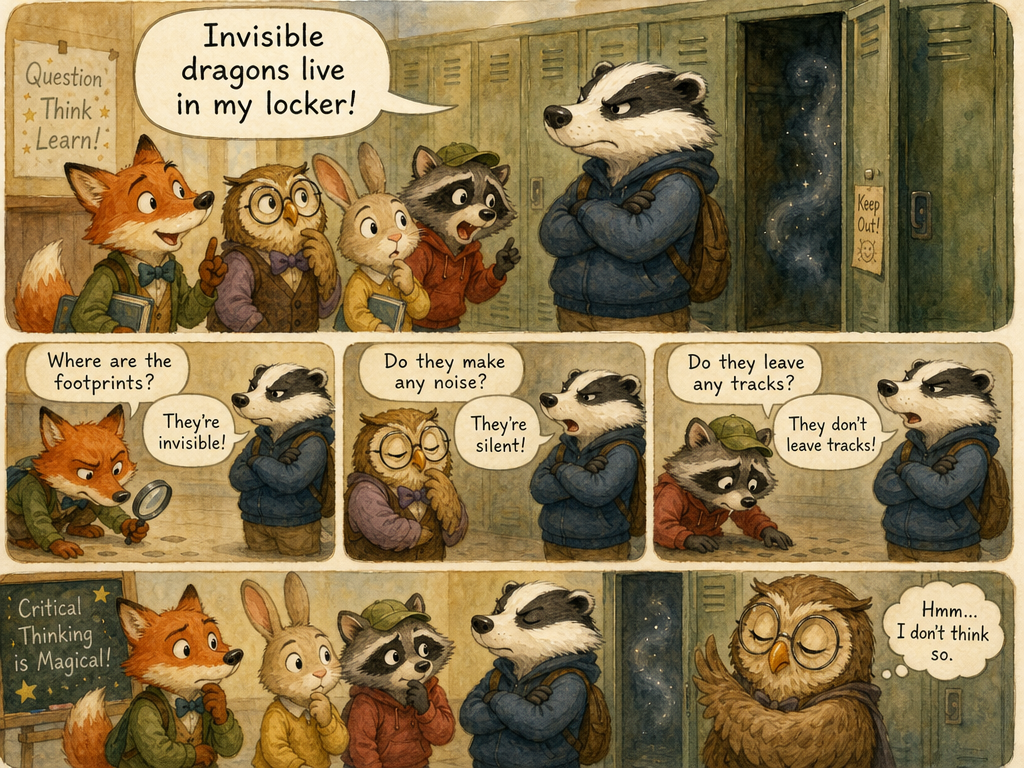
A falsifiable claim is one that COULD be proven wrong — even if it hasn't been. This sounds backwards, but it's the most important tool in all of science. If no possible evidence could ever disprove your claim, it's not a scientific claim. Good theories are brave — they stick their neck out and risk being wrong. That's what makes them powerful.
THE INVISIBLE DRAGON
No possible test could disprove this dragon. If nothing can prove it wrong, it's not a real claim — it's just a story.
THE HOROSCOPE
A prediction that can never fail isn't predicting anything at all.
REAL SCIENCE
Einstein put his theory at risk. That's why, when it passed the test, it meant something.
Without falsifiability, people can claim anything and never be proven wrong. "My lucky charm works — and when it doesn't work, that's because you didn't believe hard enough." See the problem? The claim escapes every test. That's not science. That's a trap.
For any claim, ask: "What evidence would prove this wrong?" If the person says "nothing could ever disprove it," that's a red flag. Real claims are brave enough to be tested.
Which of these is falsifiable? (A) "This medicine lowers fevers within 2 hours." (B) "Everything happens for a reason." (C) "Dropped objects fall down." For each one, describe what evidence would prove it wrong — or explain why it can't be tested.
Five steps to check any claim like a pro
Here's a secret: you already use these tools every day. You just didn't have names for them.
When you taste a cookie and say "needs more sugar" — that's observation. When you say "I bet this shortcut is faster" — that's a hypothesis. When you ask a friend to double-check your math homework — that's peer review.
Scientific thinking isn't something only adults in labs do. It's how curious people figure out what's real and what's not. And now you have the official toolkit:
The world is full of people making big claims. You now have the tools to say the most powerful thing a scientist can say:
Keep asking questions. Keep testing answers. Keep thinking like a scientist.